NON-HODGKIN
LYMPHOMA (NHL)

Exploring dysfunctional pathways, mechanisms, and biomarkers in non-
Hodgkin lymphoma to discover new insights into the progression of the
disease.


553,389

 cases of NHL are diagnosed globally each year5

60%/40%

~60% of NHL are aggressive subtypes and 40% are indolent subtypes7

INCIDENCE AND MORTALITY

There were an estimated 553,389 new cases of NHL and 250,679 deaths worldwide in 2022.5

  • An estimated 80,620 people in the US will be diagnosed with NHL during 2024 (4.0% of all new cancer cases).41
  • An estimated 20,140 people in the US will die from NHL during 2024 (3.3% of all cancer deaths).41

People older than 44 years account for 90% of NHL cases that are diagnosed.41

  • NHL is most frequently diagnosed among people aged 65 to 74 years.
  • The median age at diagnosis is 68 years.

Survival varies widely by cell type and stage of the disease.3

  • In the US, 74.3% of patients will survive 5 years past diagnosis.41
  • Five-year survival by subtype:2
    • Diffuse large B–cell lymphoma (aggressive) = ~64%
    • Follicular lymphoma (iindolent) = ~89%
    • For mantle cell lymphoma the median survival for patients with aggressive disease is 3-5 years and the median survival for patients with indolent disease is 7-10 years.27,42

NHL are a heterogeneous group of neoplasms that originate in any of the lymphoid cells: B cells, T cells, or natural killer (NK) cells.4 There are over 60 subtypes identified by the World Health Organization, each categorized by cell of origin, histological appearance, immunophenotype, and genetic characteristics.4

B–cell lymphomas account for about 85% of NHL. Major NHL subtypes include7:

  • Diffuse large B-cell lymphoma (DLBCL): ~31%
  • Chronic lymphocytic leukemia/small lymphocytic lymphoma (CLL/SLL): ~6%
  • Follicular lymphoma (FL): ~22%
  • Marginal zone lymphoma (MZL): ~8%
  • Mantle cell lymphoma (MCL): ~6% (US); 7% to 9% (Europe)7
  • Waldenstrom macroglobulinemia (WM): ~<1%

NHL subtypes are further characterized according to how the disease progresses.7

  • Indolent lymphomas
    • Slow-progressing
    • Few signs and symptoms when first diagnosed
    • About 40% of all NHL cases
    • FL is the most common subtype of indolent NHL
  • Aggressive lymphomas
    • Fast-progressing
    • Account for about 60% of all NHL cases
    • DLBCL is the most common subtype of aggressive NHL
  • MCL shares some characteristics of both indolent and aggressive NHLs

Subtypes of NHL have varied epidemiological and genetic risk factors.8 However, in most cases people diagnosed with NHL do not have any obvious risk factors, and many people who have risk factors for the disease never develop the malignancy.9

DLBCL

  • Increased young adult body-mass index (BMI), a history of B cell-activating autoimmune diseases, and Hepatitis C virus (HCV) seropositivity are associated with increased risk of developing DLBCL.9
  • BCL-2 protein overexpression is detected in approximately 30% of DLBCL cases; in approximately 90% of those cases, BCL-2 protein levels are very high.10.11
  • DLBCL with translocations of MYC and BCL2 or BCL6 as detected by fluorescence in situ hybridization (FISH) or standard cytogenetics are known as “double-hit” lymphomas. If all three are rearranged, they are referred to as “triple-hit” lymphomas. The vast majority are germinal center B-cell-like lymphomas.23
  • DLBCL may be further classified by its cell of origin.24
    • Germinal center B–cell (GCB)-type: ~50%
    • Activated B–cell (ABC)-type (poor prognosis): ~30%
    • The remaining 20% of DLBCL are unclassified
    • Gene expression profiling (GEP) can be used to divide DLBCL into GCB-type or ABC-type DLBCL, with a proportion remaining unclassifiable; attempts to divide by immunohistochemistry (IHC) have produced variable results resulting in the division of DLBCL into GCB-type and non-GCB type.4

FL

  • Risk factors include family history of NHL, β2 microglobulin > upper limit of normal, bone marrow involvement, hemoglobin < 12g/dl, the diameter of the largest involved node > 6 cm, and age > 60 years.8
  • Tumor grade, prognostic index, disease burden, GELF criteria help guide therapeutic decision making and determine appropriate candidates for a watch-and-wait approach or active therapy.25
  • BCL-2 protein overexpression is detected in 62.5% of FL cases.10
  • The vast majority of patients with BCL-2 protein overexpression develop chemoresistance and experience higher relapse rates compared with BCL-2-negative patients.10
  • BCL2/BCL6 mutation is associated with increased risk of transformed FL (tFL) and poor survival.10

CLL

  • CLL is a slow-progressing cancer in which mature clonal B lymphocytes accumulate in the bone marrow, blood, and other lymphoid tissues.

  • Vast genetic and epigenetic heterogeneity among patients and within individual patient samples has been observed; this likely contributes to the variability in clinical course among patients with CLL.25

    • The most recurrent identified genomic lesions are deletions of chromosome 13q, 17p, and 11q; and trisomy of chromosome 12.25

    • Unmutated IgVH is associated with more aggressive disease, poor prognosis, and decreased survival.26

  • The most relevant prognostic parameters are IgVH mutational status, serum β2-microglobulin, and the presence of del(17p) and/or TP53 mutations. Typically, high-risk CLL is defined in part by a genetic aberration of the TP53 gene (ie, del(17p) or TP53 mutation) or complex karyotype.27

Presentation of NHL varies greatly depending on the type and aggressiveness of the lymphoma, and the area of involvement.14

An incisional or excisional lymph node biopsy is used to establish a pathologic diagnosis of NHL. Immunophenotypic analysis by flow cytometry and/or immunohistochemistry is essential for the differentiation of various subtypes of NHL.15

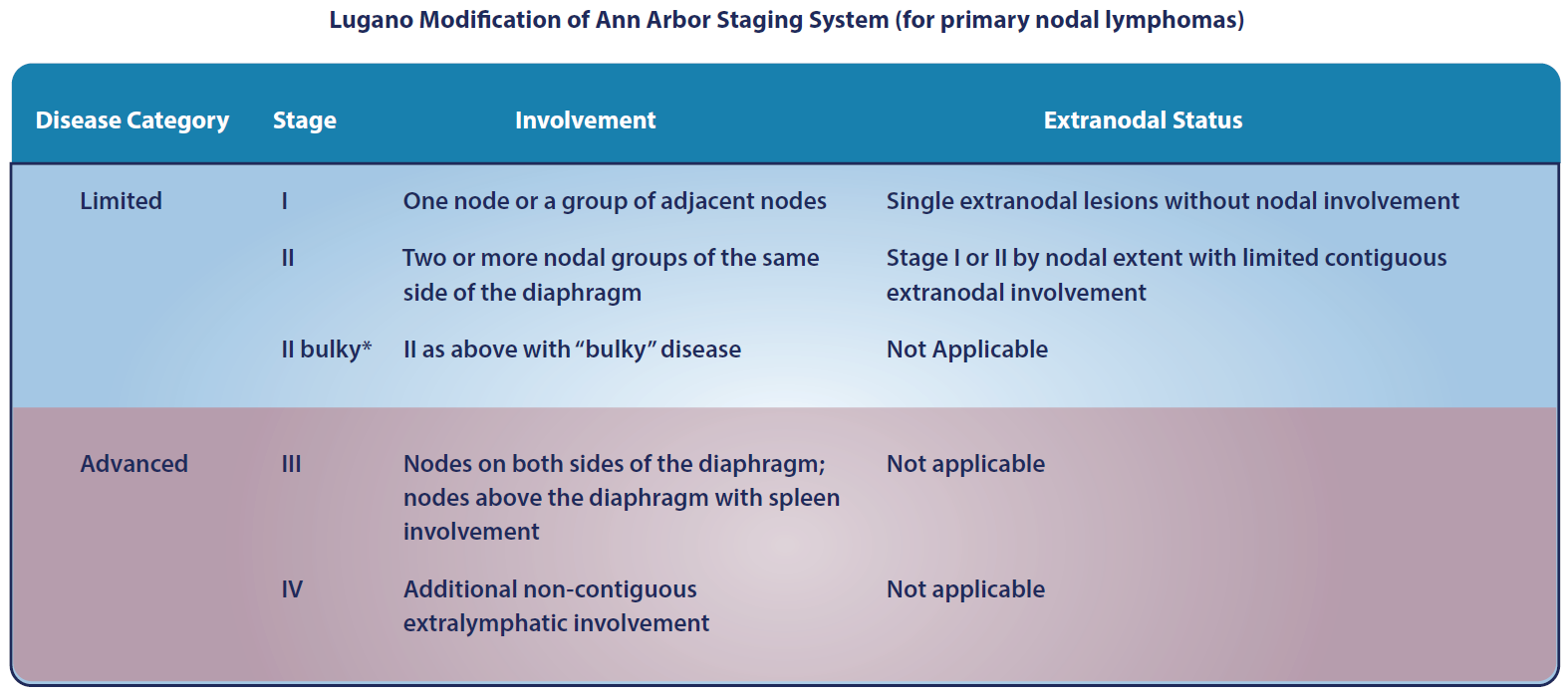
* Whether stage II bulky disease is treated as limited or advanced disease may be determined by histology and a number of prognostic factors.

NHLs are staged using this general scheme; subtype-specific grading scales are used to more accurately identify the best course of treatment for disease.15

Immunochemotherapy (rituximab or obinutuzumab + chemotherapy) has emerged as the standard of care for most B–cell NHL.16

DLBCL16

  • Immunochemotherapy is the standard of care for DLBCL in the front-line setting
  • Although DLBCL is curable following front-line treatment, approximately one-third of patients eventually relapse or are initially refractory to these treatments.

FL17,18,19

  • Due to the heterogeneity of FL, there is no uniform standard approach for treating FL and patient factors must be considered when deciding therapy.
  • While most patients have disseminated disease at diagnosis, they are frequently asymptomatic and have historically been observed without initial therapy ("watch-and-wait").19,20
  • For patients with symptomatic disease who are likely to be treated, immunochemotherapy is the standard of care.25
  • Despite the improved effectiveness of immunochemotherapy regimens, FL is considered incurable and approximately 20% of patients with FL experience progression of disease within 2 years of first-line therapy.17,18
  • In particular, progression within 24 months of the start of 1L therapy (POD24) is a predictor of poor survival, with only 34%–50% of patients alive at 5 years (vs ~90% in late-relapsed FL).18
CLL
  • Numerous advances in the treatment of CLL have been made within the last few decades, including the introduction of novel classes of targeted small molecules such as BCL2 inhibitors or BTK inhibitors. 

  • Randomized clinical trials have studied these therapeutics vs chemoimmunotherapy in both the first-line and relapsed/refractory setting.28

  • CLL is a chronic disease; therefore, most patients will relapse on or after treatment and require multiple lines of therapy, especially high-risk subgroups.

  • The major treatment challenge has now shifted from having few therapeutic choices to how best to sequence and combine available agents.28,29

Relevant Cancer Targets


CD19

Learn about CD19 and its expression on B cells signaling MORE>


BTK

Learn about BTK and B cell signaling MORE>

CD3xCD20 BISPECIFICS

Learn about CD3 on T cells and bispecific targeting of CD20 MORE>


MALT1

Learn about MALT1 and NF-κB signaling. MORE>

  1. Fitzmaurice, et al. Global, Regional, and National Cancer Incidence, Mortality, Years of Life Lost, Years Lived With Disability, and Disability-Adjusted Life-Years for 29 Cancer Groups, 1990 to 2016: A Systematic Analysis for the Global Burden of Disease Study. JAMA Oncol. 2018;4(11):1553-1568.
  2. Howlader N, Noone AM, Krapcho M, et al (eds). National Cancer Institute. SEER Cancer Statistics Review, 1975-2017. Updated April 2020 based on November 2019 SEER data submission. https://seer.cancer.gov/csr/1975_2017/.
  3. Siegel RL, Miller KD, Jemal A. Cancer Statistics, 2017. CA Cancer J Clin. 2017;67(1):7-30.
  4. Swerdlow SH, Campo E, Pileri SA, et al. The 2016 revision of the World Health Organization classification of lymphoid neoplasms. Blood. 2016;127:2375-2390.
  5. International Agency for Research on Cancer. (2022). GLOBOCAN: Global Cancer Observatory. World Health Organization. https://gco.iarc.who.int/
  6. Blood Cancer United. 2025. https://bloodcancerunited.org/blood-cancer/lymphoma/non-hodgkin-lymphoma-nhl. Accessed November 2025.
  7. Glass S, Phan A, Williams JN, Flowers CR, Koff JL. Integrating understanding of epidemiology and genomics in B-cell non-Hodgkin lymphoma as a pathway to novel management strategies. Discov Med. 2016;21(115):181-188.
  8. Mayo Foundation for Medical Education and Research. Diseases and Conditions: Non-Hodgkin's Lymphoma: Risk Factors. Accessed November 2025 http://www.mayoclinic.org/diseases-conditions/non-hodgkins-lymphoma/basics/risk-factors/con-20027792
  9. Mahmoud HM, El-Sakhawy YN. Significance of Bcl-2 and Bcl-6 immunostaining in B-non Hodgkin's lymphoma. Hematol Rep. 2011;3(3):e26.
  10. Wang J, Zhou M, Xu J, Chen B, Ouyang J. Combination of BCL-2 and MYC protein expression improves high-risk stratification in diffuse large B-cell lymphoma. Onco Targets Ther. 2015;8:2645-2650.
  11. Perez-Galan P, Dreyling M, Wiestner A. Mantle cell lymphoma: biology, pathogenesis, and the molecular basis of treatment in the genomic era. Blood. 2003;101(6):2125-2131.
  12. Parekh S, Weniger MA, Wiestner A. New molecular targets in mantle cell lymphoma. Semin Cancer Biol. 2011;21(5):335-346.
  13. National Cancer Institute. Adult Non-Hodgkin Lymphoma Treatment (PDQ®)-Health Professional Version. Accessed November 2025.https://www.cancer.gov/types/lymphoma/hp/adult-nhl-treatment-pdq.
  14. Cheson B, Fisher RI, Barrington SF, et al. Recommendations for initial evaluation, staging, and response assessment of Hodgkin and non-Hodgkin lymphoma: the Lugano classification. J Clin Oncol. 2014;32:3059-3067.
  15. Amin AD, Peters TL, Li L, et al. Diffuse large B-cell lymphoma: can genomics improve treatment options for a curable cancer? Cold Spring Harb Mol Case Stud. 2017;3(3):a001719.
  16. Press OW, et al. Phase III randomized intergroup trial of CHOP plus rituximab compared with CHOP chemotherapy plus 131iodine-tositumomab for previously untreated follicular non-Hodgkin lymphoma: SWOG S0016. J Clin Oncol. 2013;31(3):314-320.
  17. Casulo C, et al. Early relapse of follicular lymphoma after rituximab plus cyclophosphamide, doxorubicin, vincristine, and prednisone defines patients at high risk for death: an analysis from the National LymphoCare Study. J Clin Oncol. 2015;33(23):2516-2522.
  18. Armitage JO, Longo DL. Is watch and wait still acceptable for patients with low-grade follicular lymphoma? Blood. 2016;127(23):2804-2808.
  19. Kahl B. Is there a role for "watch and wait" in follicular lymphoma in the rituximab era? Hematology Am Soc Hematol Educ Program. 2012;2012:433-438.
  20. Fakhri B, Kahl B. Current and emerging treatment options for mantle cell lymphoma. Ther Adv Hematol. 2017;8(8):223-234.
  21. Parrott M, Rule S, Kelleher M, Wilson J. A systematic review of treatments of relapsed/refractory mantle cell lymphoma. Clin Lymphoma Myeloma Leuk. 2018 Jan;18(1):13-25.e6.
  22. Smith SM, et al. Aggressive B-cell lymphoma: the double-hit and double-expressor phenotypes. Clin Adv Hematol Oncol. 2017;15(1):40-42.
  23. Barton S, et al. Are we ready to stratify treatment for diffuse large B-cell lymphoma using molecular hallmarks? Oncologist. 2012;17(12):1562-73.
  24. Riedell PA, et al. How to Refine Treatment Choice in Follicular Lymphoma: From Low-Tumor Burden to High-Risk Follicular Lymphoma. Am J Hem/Onc. 2016;12(6):15-19.
  25. Hoster E, et al. A new prognostic index (MIPI) for patients with advanced-stage mantle cell lymphoma. Blood. 2008;111(2):558-65.
  26. Sarkozy C, et al. Complex karyotype in mantle cell lymphoma is a strong prognostic factor for the time to treatment and overall survival, independent of the MCL international prognostic index. Genes Chromosomes Cancer. 2014;53(1):106-16.
  27. Olszewski AJ, et al. Survival of patients with marginal zone lymphoma. Cancer. 2013 ;119(3):629-38.
  28. Lai R, et al. Frequency of bcl-2 expression in non-Hodgkin's lymphoma: a study of 778 cases with comparison of marginal zone lymphoma and monocytoid B-cell hyperplasia. Mod Pathol. 1998 ;11(9):864-869.
  29. Castillo JJ, et al. Overall survival and competing risks of death in patients with Waldenström macroglobulinaemia: an analysis of the Surveillance, Epidemiology and End Results database. Br J Haematol. 2015;169(1):81-9.
  30. Kyle RA, et al. Prognostic markers and criteria to initiate therapy in Waldenstrom's macroglobulinemia: consensus panel recommendations from the Second International Workshop on Waldenstrom's Macroglobulinemia. Semin Oncol. 2003;30(2):116-20
  31. Treon SP, et al. Somatic mutations in MYD88 and CXCR4 are determinants of clinical presentation and overall survival in Waldenström macroglobulinemia. Blood. 2014;123(18):2791-2796.
  32. Castillo JJ, et al. Future therapeutic options for patients with Waldenström macroglobulinemia. Best Pract Res Clinl Haematol. 2016;29(2):206-215.
  33. Zucca E, et al. The spectrum of MALT lymphoma at different sites: biological and therapeutic relevance. Blood. 2016;127(17):2082-2092.
  34. Thieblemont C, et al. Optimizing therapy for nodal marginal zone lymphoma. Blood. 2016;127(17):2064-2071.
  35. Arcaini L, et al. Splenic marginal zone lymphoma: from genetics to management. Blood. 2016;127(17):2072-2081.
  36. Rummel MJ, et al. Bendamustine plus rituximab versus CHOP plus rituximab as first-line treatment for patients with indolent and mantle-cell lymphomas: an open-label, multicentre, randomised, phase 3 non-inferiority trial. Lancet. 2013;381(9873):1203-10.
  37. Kastritis E, et al. Dexamethasone, rituximab, and cyclophosphamide as primary treatment of Waldenström macroglobulinemia: final analysis of a phase 2 study. Blood 2015. 126(11):1392-4.
  38. Dimopoulos MA, et al. Primary therapy of Waldenstrom macroglobulinemia (WM) with weekly bortezomib, low-dose dexamethasone, and rituximab (BDR): long-term results of a phase 2 study of the European Myeloma Network (EMN). Blood. 2013;122(19):3276-82.
  39. Klasa RJ. Targeting the proapoptotic factor Bcl-2 in non-Hodgkin's lymphoma. Oncology. (Williston Park). 2004;18(13 Suppl 10):25-31.
  40. NCI. Cancer Stat Facts: Non-Hodgkin Lymphoma (NHL). Accessed March 2025. https://seer.cancer.gov/statfacts/html/nhl.html
  41. Furtado M and Rule S. Indolent mantle cell lymphoma. Haematologica. 2011 Aug; 96(8): 1086–1088.