OVERVIEW

Novel cancer therapies that exploit tumor intrinsic properties can be directed by tumor antigens or by tumor dependencies that profoundly impact cancer cell fate. Targeting antigens involves therapies directed against markers that are present on cancer cells but not on normal cells.1 Targeting tumor dependencies involves therapies directed against mechanisms and dependencies that are unique to the cancer.2
- The ideal tumor antigen would be a “tumor-specific antigen,” which is an antigen that is solely expressed by malignant cells; tumor-specific antigens provide a unique target that will lead to maximal tumor elimination with minimal off-target toxicity.1
- However, tumor-specific antigens are rare, as most antigens that are expressed by malignant cells are also found in normal tissues. Therefore, the more accurate designation of these antigens is “tumor-associated antigens (TAA)”, rather than tumor-specific.1
- TAAs can be broadly categorized into three groups:1
- Aberrantly expressed self-antigens
- Mutated self-antigens
- Tumor-specific antigens
BIOLOGY OF TUMOR-ASSOCIATED ANTIGENS1

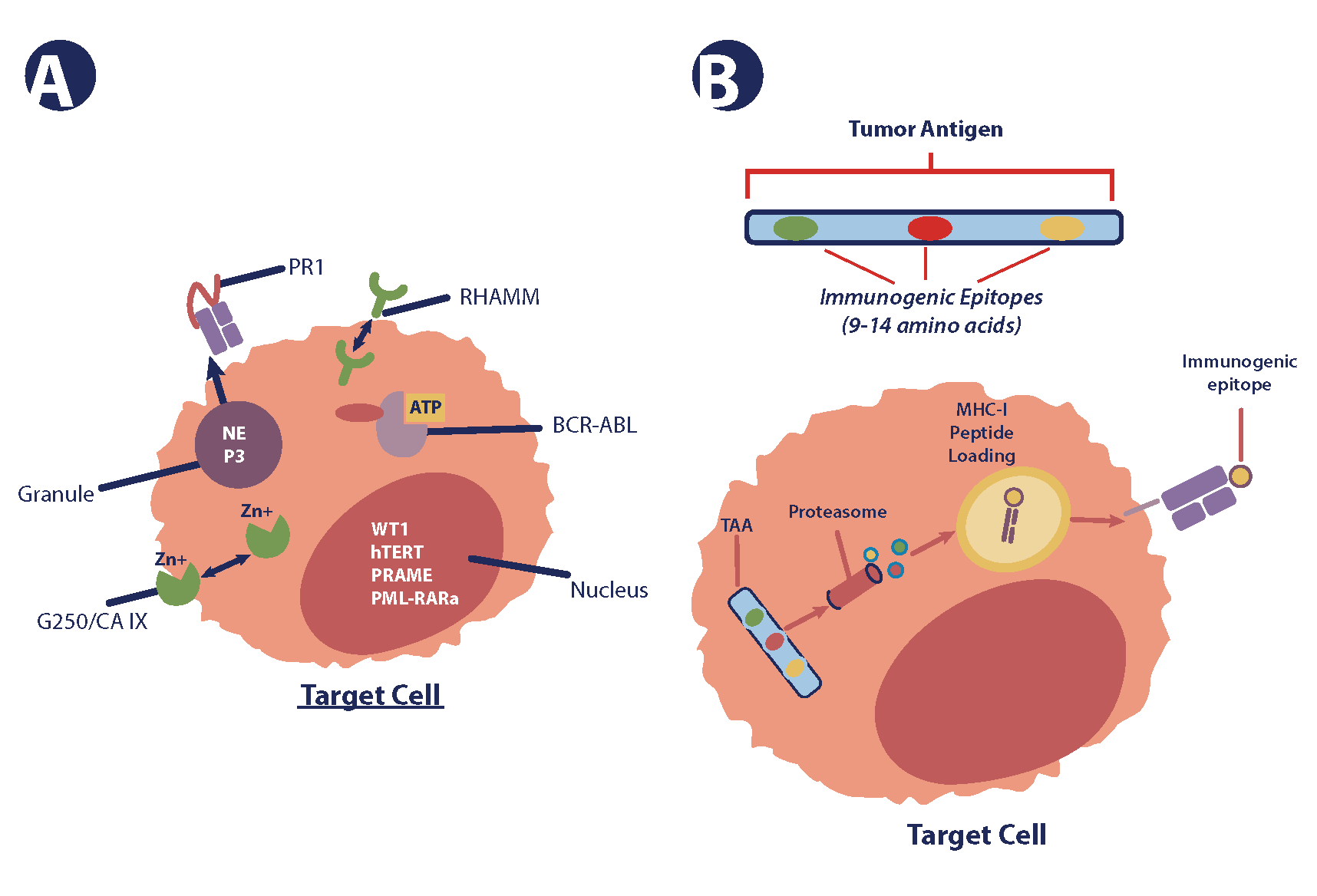
- (A)TAAs originate in various cellular compartments, including the nucleus, granules, cell membrane and cytoplasm. However, in order for effective antigen presentation to occur, (B) the TAA must localize to cellular compartments that facilitate antigen presentation.1
- The abnormal expression of TAA by malignant cells, either through overexpression or aberrant localization, can lead to preferential presentation of TAA-derived immunogenic epitopes on the target cell surface.1
Therapeutic Potential1
- A feature that makes a TAA ideal for immunotherapy is the dependency of the malignant cells on the expression of the TAA.
- Targeting TAAs that drive the proliferation of the malignant clone will not only contribute to the reduction of the disease burden, but may also eliminate the underlying malignant clone/stem cell that must ultimately be eradicated for achieving cure.
Tumor Dependency:
The tumor dependency approach has produced new targeted therapies that may address one or more of the biological hallmarks of cancer that tumors exploit to proliferate, such as, resisting cell death (avoiding apoptosis) sustaining proliferative signaling, evading growth suppressors, and enabling replicative immortality.2 The ability of tumor cell populations to expand in number is determined not only by the rate of cell proliferation (cell replication), but also by the rate of cell attrition (cell death):2
- Apoptosis, or programmed cell death, represents a major source of cell attrition.2
- Sensors (intrinsic or extrinsic) are responsible for monitoring the extracellular and intracellular environment for conditions of normality or abnormality that influence whether a cell should live or die; these sentinels include cell surface receptors that bind survival or death factors.2
- Effector enzymes (caspases) are regulated by the sensors and ultimately carry out the execution of the death program through selective destruction of subcellular structures and organelles and of the genome.2
- The BCL-2 family of proteins in the intrinsic apoptosis pathway are “sensors” or “regulators” that control cell death primarily by direct binding interactions that regulate mitochondrial outer membrane permeabilization (MOMP), leading to the irreversible release of cytochrome C, subsequent caspase (“effectors”) activation, and the resulting apoptosis.3
Therapeutic Potential
- Acquired resistance to apoptosis is a hallmark of most, if not all, types of cancer.2
- In cancer, apoptosis evasion through dysregulation of specific BCL-2 family genes is a recurring event.4
- Dysregulation of the apoptotic pathways can not only promote tumorigenesis, but can also render cancer cells resistant to conventional anti cancer agents because, chemotherapy- and radiotherapy-induced killing of cancer cells is mainly mediated through activation of apoptosis.5
- Overexpression of anti-apoptotic BCL-2 family proteins (BCL-2, BCL-XL, BFL-1/A1, BCL-W and MCL-1) disrupts the dynamic balance of anti- and pro-apoptotic proteins, which may promote cancer cell survival.5,6
- Strategies to inhibit anti-apoptotic BCL-2 proteins include reducing protein expression by targeting the corresponding mRNA with an antisense oligonucleotide compound as well as blocking anti-apoptotic activity by targeting at the protein level.5,6
- There is interest in developing drugs that mimic the action of the BH3 domain by binding to one or more of the BCL-2-like proteins and triggering the apoptotic program.6
Related Research
- Alatrash G, Crain AK, Molldrem, JJ. Chapter 7 – Tumor-Associated Antigens. In: Immune Biology of Allogeneic Hematopoeitic Stem Cell Transplantation. 2nd ed. Academic Press;2019:107-125
- Hanahan D, et al. Hallmarks of cancer: the next generation. Cell. 2011;144(5):646-674. (image)
- Kale J, et al. BCL-2 family proteins: changing partners in the dance towards death. Cell Death Differ. 2018;25:65–80.
- Ashkenazi A, et al. From basic apoptosis discoveries to advanced selective BCL-2 family inhibitors. Nat Rev Drug Discov. 2017;16:273-284. (image)
- Plati J, Bucur O, Khosravi-Far R. Apoptotic cell signaling in cancer progression and therapy. Integr Biol (Camb). 2011;3:279-296.
- Adams JM, Cory S. The Bcl-2 apoptotic switch in cancer development and therapy. Oncogene. 2007;26:1324-1337.
- Agarwal B, et al. Bcl-2 family of proteins in indolent B-cell non-Hodgkin's lymphoma: study of 116 cases. Am J Hematol. 2002;70(4):278-82.