BCMA x CD38 x CD3 TsAb
OVERVIEW

T cell receptors (TCRs) are protein complexes formed by six different polypeptides. The CD3 complex is part of the TCR complex and is composed of two CD3ε, one CD3γ, one CD3δ, and two CD3ζ chains.1,2 The CD3 complex ensures signal transduction and plays an important role in T cell activation.1-3
BCMA (B cell maturation antigen) is a transmembrane glycoprotein only induced in late memory B cells committed to plasma cell (PC) differentiation and is present on all PCs. BCMA supports the survival of long-lived PCs, the production of antibodies, and immunoglobulin class switching.4
CD38 is a transmembrane glycoprotein that is involved in cell signaling, adhesion, and modulation of immune cell activation.5
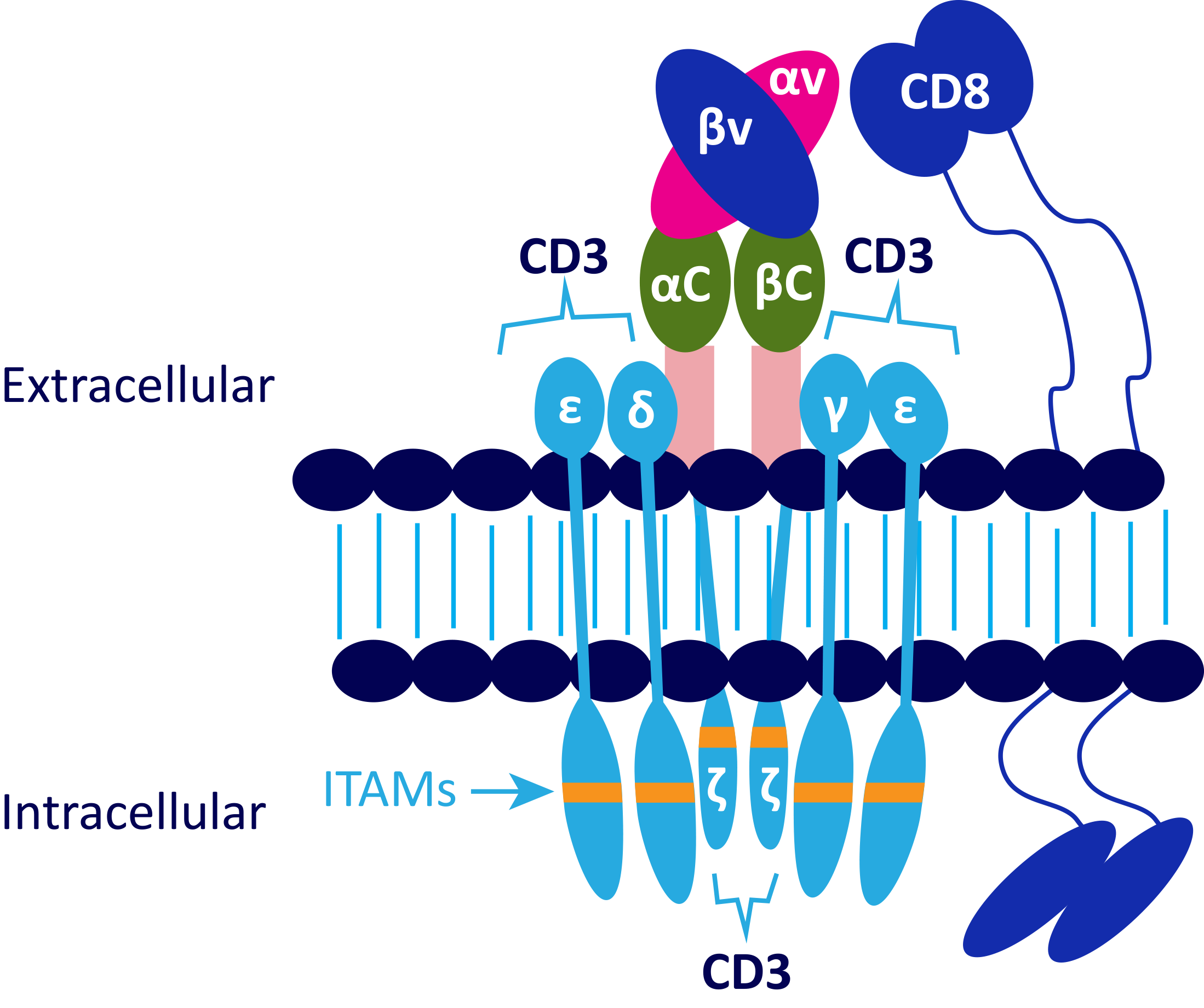
Diagram of the T-cell receptor (TCR) complex.
- CD3 trispecific antibodies (TsAb) induce the activation and cytotoxic activity of effector T-cells, enabling lysis of target-expressing B-cells.5-7
- CD3 TsAb activate T cells by binding CD3 on T cells and a tumor-associated antigen (TAA), such as BCMA and CD38, on the B-cells. Consequently, available T cells can bind to target-expressing cells irrespective of the peptide/major histocompatibility complex (MHC) specificity of their TCR.1,3
- Activation of the TCR-CD3 complexes leads to the formation of a cytolytic synapse between the T cell and the B-cell which results in the release of perforin and granzymes and subsequent B-cell death by apoptosis.1
- A BCMA x CD38 x CD3 trispecific antibody simultaneously binds to BCMA and CD38 on plasma cells and to CD3 on T cells, inducing activation and cytotoxic activity of T cells and enabling lysis of BCMA and CD38-expressing plasma cells.4,6,8-10
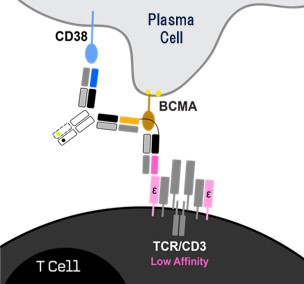
- T cell redirection with TsAb, in which binding arms recognizes a tumor antigens and CD3 on T cells.
- CD3 TsAbs in clinical trials either lack an Fc region or contain an engineered Fc domain to minimize interaction with Fc receptors.1,3
- The presence of an Fc domain increases the in vivo half-life through binding to the neonatal Fc receptor.3
- A key CD3 TsAb development consideration is the need for a format that either significantly limits or eliminates cytokine release syndrome (CRS) because CRS appears to be dose-limiting in most cases for this class of molecules.1
IMPLICATIONS IN CANCER

Immunotherapy of cancer with CD3 TsAb is growing field. The idea of using the cytotoxic capacity of T cells through CD3 bsAb to kill tumor cells dates back to the 1980’s and the use of CD3 TsAb builds on this work and is now an emerging field.5,11,12
BCMA and CD38 are overexpressed in MM plasma cells, promoting proliferation and survival.4,5 Overexpression of both BCMA and CD38 are associated with an immunosuppressive bone marrow microenvironment.4,8,10 BCMA and CD38 are well-established targets in R/R MM.4,5
Trispecific antibodies that bind to BCMA and CD38 and CD3 can recruit T cells from the body’s own immune system to act as cytotoxic effectors against B cells, including tumor cells.1,9
Related Research
- Strohl WR, Naso M. Bispecific T-cell redirection versus chimeric antigen receptor (CAR)-T cells as approaches to kill cancer cells. Antibodies (Basel). 2019;8(3):41.
- Alcover A, et al. Cell viology of T cell receptor expression and regulation. Annu Rev Immunol. 2018;36:85-107.
- Benonisson H, et al. CD3-bispecific antibody therapy turns solid tumors into inflammatory sites but does not install protective memory. Mol Cancer Ther. 2019;18(2):312-322.
- Cho SF, et al. Targeting B cell maturation antigen (BCMA) in multiple myeloma: potential uses of BCMA-based immunotherapy. Frontiers in immunology. 2018 Aug 10;9:1821.
- Gozzetti A, Ciofini S, Simoncelli M, Santoni A, Pacelli P, Raspadori D, Bocchia M. Anti CD38 monoclonal antibodies for multiple myeloma treatment. Hum Vaccin Immunother. 2022 Nov 30;18(5):2052658. doi: 10.1080/21645515.2022.2052658. Epub 2022 Apr 11.
- Quach H, et al. IMS 2025.
- Labrijn AF, Janmaat ML, Reichert JM, Parren PWHI. Bispecific antibodies: a mechanistic review of the pipeline. Nat Rev Drug Discov. 2019 Aug;18(8):585-608.
- Strohl WR, Naso M. Bispecific T-Cell Redirection versus Chimeric Antigen Receptor (CAR)-T Cells as Approaches to Kill Cancer Cells. Antibodies (Basel). 2019 Jul 3;8(3):41.
- Benonisson H, et al. CD3-Bispecific Antibody Therapy Turns Solid Tumors into Inflammatory Sites but Does Not Install Protective Memory. Mol Cancer Ther. 2019;18(2):312-322.
- Alcover A, et al. Cell Biology of T Cell Receptor Expression and Regulation. Annu. Rev. Immunol. 2018. 36:85–107.
- Yawara Kawano, Saki Kushima, Hiroyuki Hata, Masao Matsuoka. The Role of CD38 in Multiple Myeloma Cell Biology. Blood (2021) 138 (Supplement 1): 1580. https://doi.org/10.1182/blood-2021-150884
- Tapia-Galisteo A, Compte M, Álvarez-Vallina L, Sanz L. When three is not a crowd: trispecific antibodies for enhanced cancer immunotherapy. Theranostics. 2023 Jan 22;13(3):1028-1041. doi: 10.7150/thno.81494. PMID: 36793863; PMCID: PMC9925307.